IDEAL ThinkersAn AI literacy and fluency curriculum

An AI literacy and fluency curriculum for primary schools, Year 1 to Year 6

IDEAL Thinkers

Children are growing up alongside AI. It chooses the next video they watch, finishes their sentences, listens from the kitchen worktop and answers questions in a voice that sounds friendly and sure of itself. Most of them meet it long before anyone teaches them what it is.

IDEAL Thinkers gives primary pupils the knowledge to understand how AI works, the habits to question what it tells them, the values to use it well, and the judgement to know when it helps their learning and when it gets in the way.

The road map

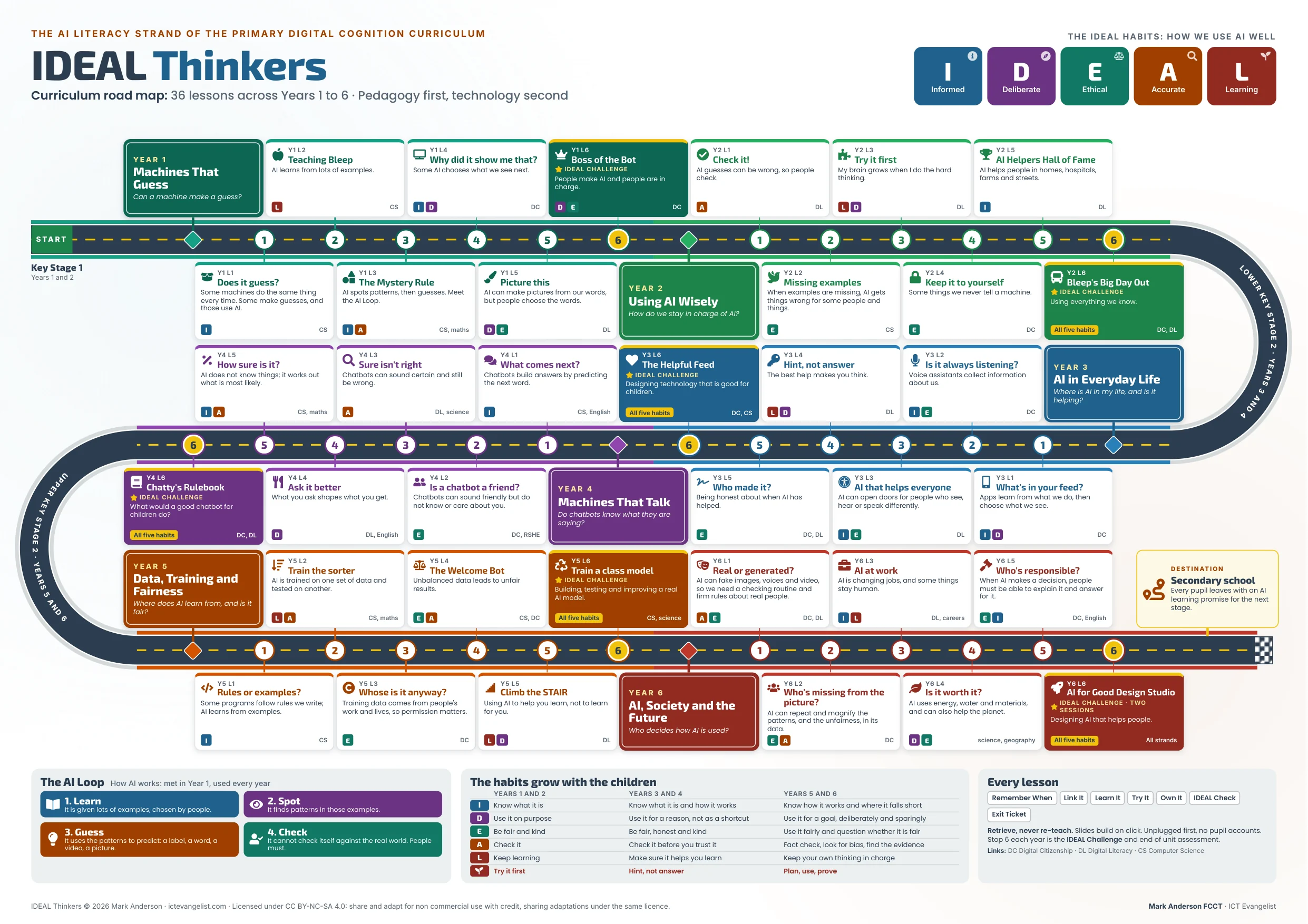
All 36 lessons on one page, from Year 1 to secondary school.

The IDEAL Thinkers curriculum road map, showing all 36 lessons from Year 1 to Year 6

Explore the curriculum map

Pedagogy first, technology second

It is built on the principle behind all of my work: pedagogy first, technology second. Nearly every activity works without a single pupil device. Where technology appears, the teacher leads it, with a clear purpose and safeguarding built in.

Every lesson can be picked up and taught with minimal preparation, and every deck and plan can be copied, adapted and made your own.

The AI Loop: Learn, Spot, Guess, Check

  1. 1LearnIt is given lots of examples (data), chosen by people.
  2. 2SpotIt finds patterns in those examples.
  3. 3GuessIt uses the patterns to make a prediction: a label, a next word, a video, a picture.
  4. 4CheckIt cannot check itself against the real world. People must.

See the three threads that run through every lesson

The frameworks it links to

IDEAL Thinkers doesn't sit on its own. Here's what it connects to, and how.

The Primary Digital Cognition Curriculum

The Primary Digital Cognition Curriculum, published in The EdTech Playbook, has four strands: Digital Citizenship, Digital Literacy, Computer Science and AI Literacy. IDEAL Thinkers is the full, teachable AI Literacy strand. AI does not stay in its own box, though, so every lesson also shows its links to the other three strands. Schools can see AI literacy as part of a whole approach to digital cognition rather than a bolt-on.

The National Curriculum for computing (England)

The lessons address the KS1 and KS2 statements on using technology safely, respectfully and responsibly; keeping personal information private; recognising common uses of information technology beyond school (KS1); understanding how search results are selected and ranked, and being discerning in evaluating digital content (KS2).

SEAME

SEAME is a framework from the Raspberry Pi Computing Education Research Centre that sorts what we teach about AI into four levels: social and ethical, applications, models and engines (how AI works). Lessons cover all four levels of the model: social and ethical, applications, models and, through unplugged activities, engines.

The new computing curriculum

BCS is drafting a revised National Curriculum for Computing for first teaching from September 2028, with foundational AI concepts included. This curriculum will be mapped against the draft once it is published.

Universal Design for Learning

Every plan offers multiple ways to engage, to access content and to show understanding, with adaptations for support and stretch in each lesson.

Cognitive science

Spaced retrieval, concrete before abstract, worked examples and modelling, explicit vocabulary teaching, dual coding through consistent visual models, and frequent low stakes checks for understanding.

IDEAL

My framework for informed learning with AI: Informed, Deliberate, Ethical, Accurate, Learning. Every lesson is tagged with the IDEAL letters it develops, and the wording grows with the children.

More on IDEAL

STAIR

In Upper KS2, pupils plan how AI could support a specific learning goal using STAIR (Specific, Tell, Actionable, Iterate, Role), as part of the Learning Well habit: plan, use, prove.

More on Learning Well

Wider curriculum: RSHE, science, maths, English, geography and careers links are flagged in each lesson plan.

Common questions

What is IDEAL Thinkers?

A free AI literacy and fluency curriculum for primary schools, from Year 1 to Year 6. There are 36 lessons, six for each year group, and every lesson has a lesson plan and a slide deck. It's the AI Literacy strand of the Primary Digital Cognition Curriculum from The EdTech Playbook.

Is it free?

Yes, for schools and teachers. It's licensed under CC BY-NC-SA 4.0, so you can copy and adapt it for your own teaching as long as you credit it and share any adapted versions under the same licence. It cannot be used for commercial purposes.

Do pupils need devices or their own AI accounts?

No. Every lesson can be taught without pupil devices, and pupils never need an AI account; most generative AI tools have a minimum age of 13. Where a demonstration helps, the teacher runs it on a school approved tool, and every deck includes prepared examples in case a live demonstration isn't possible on the day.

How long is each lesson?

60 minutes, and every lesson plan includes a 45 minute version. Each year's six lessons are planned as a half-term unit, and the sixth lesson is an IDEAL Challenge that doubles as the end of unit assessment.

Does it cover the National Curriculum for computing?

It addresses the KS1 and KS2 statements on using technology safely, respectfully and responsibly, keeping personal information private, recognising uses of information technology beyond school, understanding how search results are selected and ranked, and being discerning in evaluating digital content. It will be mapped against the revised computing curriculum once the draft is published.

Can I use it with Microsoft 365?

Yes. Every slide deck downloads as PowerPoint and every lesson plan as Word, and on Google Workspace you can make your own copy in Google Drive.